Dissent, Rifts and Renewal: Unpacking the Myth of Roar and Its Impact on Australian Painting
- Andrew McIlroy
- Jan 4
- 5 min read


In 1982, amid a cultural climate dominated by minimalism, conceptualism and imported theory, a group of young Melbourne painters opened an artist-run gallery in a former shoe factory on Brunswick Street, Fitzroy. They called it Roar Studios. The name was not subtle. It announced impatience with a closed and conservative gallery system and an unapologetic return to painting that was raw, expressive and bodily. Roar did not ask permission. It rejected the idea that artists should wait to be chosen, and instead built its own platform, staking a claim for painting at a moment when the medium was widely dismissed as exhausted or regressive.
Roar’s emergence belongs to a recurring Australian story: artists organising against perceived stagnation, forming collectives that promise openness, and then fracturing under the pressures of success, scarcity, and reputation. In that sense, Roar sits in a lineage that stretches back at least to the post-war period and the internal disputes that beset Victoria's Contemporary Art Society. Both episodes reveal less about stylistic disagreements than about power - who speaks for a movement, who benefits from its name, and who gets written into history.
Roar’s painters chose paint at a moment when painting felt embattled. Hard-edged abstraction, minimalism, and the rising authority of conceptualism dominated institutions and art schools. Roar’s answer was emphatically material: raw handling, expressive drawing, an insistence on feeling over theory. The work was not unified by a single look so much as by a shared refusal to be patient.

Richard Birmingham today, the founder of Roar at its original Green Street studio in Prahran
That refusal extended to infrastructure. Rather than courting commercial galleries, the artists built their own. Brunswick Street in 1982 was no curated destination - more a tough corridor marked by Housing Commission flats and the Rob Roy Hotel than by cafés and boutiques. Roar’s opening, reportedly drawing a crowd in the thousands, felt like an event because it was an interruption. The gallery functioned as a subsidised platform, funded by the artists themselves and by raucous auctions that doubled as performances. It was, briefly, a commons.
Christopher Heathcote later described Roar as a “creative irritant,” a rare vanguard in late-20th-century Australian art precisely because it operated in spite of the system rather than within it. That assessment captures the heat of the moment - but it also sets up the question that would haunt Roar thereafter: irritant to whom, and for how long?

Mark Howson's poster for the first Roar exhibition, 1982
No account of Roar can avoid David Larwill, its most famous and, in many ways, most catalytic figure. Charismatic, prolific and theatrically confident, Larwill drew crowds simply by painting, turning the act itself into a form of performance. His work - brash, figurative and unapologetically expressive - came to embody what many outsiders understood as the “Roar style,” even though the collective itself was far more diverse.
Larwill’s rapid ascent into the commercial gallery system gave Roar visibility and legitimacy, but it also accelerated internal tensions. His success exposed the fault line between Roar as a collective experiment and Roar as a recognisable brand.
For some, Larwill was proof that Roar’s challenge to the establishment had worked; for others, his trajectory marked the moment when individual advancement began to eclipse the cooperative ideals on which the studio was founded. In this sense, Larwill was not merely Roar’s breakout artist but the figure through whom its contradictions became impossible to ignore.

Artist David Larwill (1956-2011)
The Inevitable Split
As with the Contemporary Arts Society after the war, Roar’s first rift arrived when opportunity knocked. Commercial success, especially when mediated by a single gallery and a handful of artists, changed the calculus. The Roar name - originally a collective banner - began to function as a brand. Selection replaced inclusion. Some artists advanced quickly; others found themselves excluded from exhibitions that traded on the movement they had helped to build.
This pattern mirrors the Contemporary Art Society's post-war troubles, when disagreements about modernism, representation, and institutional access hardened into factions. In both cases, the original promise of collective purpose collided with individual careers. The rhetoric of openness could not withstand the realities of limited wall space, market attention, and the seductions of legitimacy.

George Bell President of the Victorian Contemporary art Society from 1938 to 1940. After disagreement over the direction of the Society, Bell and 83 other members seceded in 1940, and John Reed was elected president.
What makes Roar’s story particularly contentious is not that it split - most movements do - but how its history has been told since. Accounts that compress Roar into a small canon of names risk mistaking outcome for origin. They flatten a messy, plural beginning into a tidy success story, convenient for promotion but inadequate as history.
Overrated or Misunderstood?
Is Roar overrated? The answer depends on what one expects of a movement. If the measure is stylistic coherence or long-term institutional dominance, then Roar can look noisy and short-lived. If the measure is impact - on careers launched, on the confidence it gave painters to persist, on the reminder that artist-run spaces can reset a scene - then its importance is hard to dismiss.
Roar did not “win” the argument against theory or conceptualism, nor did it need to. Its true place lies in demonstrating that Australian art renews itself through cycles of dissent. Like the VCAS before it, Roar exposed the fragility of any consensus and the speed with which collectives can reproduce the hierarchies they oppose.
Where Are They Now?
Time has scattered the Roar artists. Some became well-known, their early debts repaid many times over in auction rooms and retrospectives. Others continued working outside the spotlight, teaching, exhibiting intermittently, or maintaining studios far from Brunswick Street’s transformed precinct. Gentrification closed the original chapter - apartments replaced the factory - but it did not settle the argument.
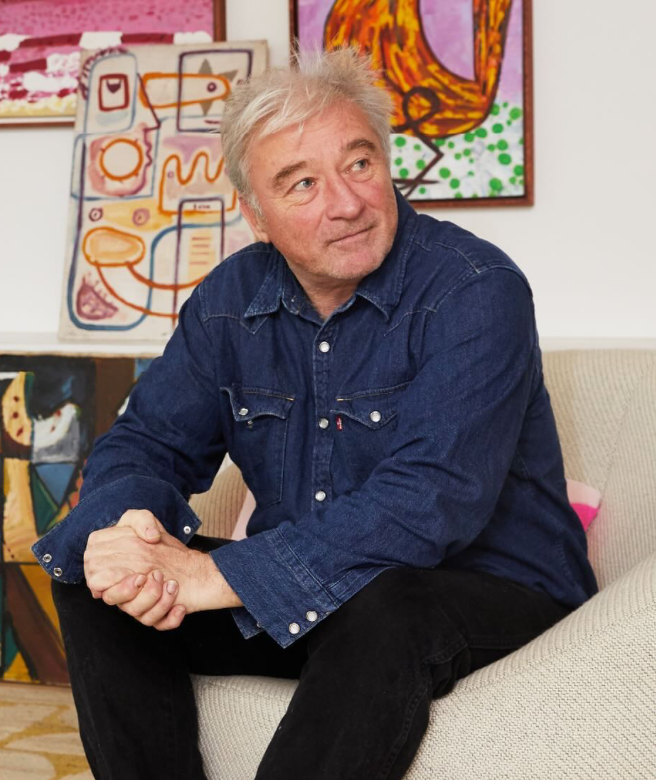
Founding Member of Roar, Mark Schaller
Reunions and anniversary exhibitions have offered moments of reconciliation, though they have also reignited disputes about who gets included under the Roar banner and why. Developers and patrons have occasionally revived the name, proof that Roar still carries cultural capital. Whether that capital serves history or commerce remains contested.
The Lesson of Roar
Roar’s legacy is not a style so much as a caution. Artist-run initiatives matter most when they are honest about their contradictions. They begin in solidarity and end, often, in selection. The danger is not division itself but amnesia - allowing a few voices to stand in for many, or allowing a brand to overwrite a collective experiment.
Roar’s true significance lies not in the mythology that has grown around a handful of names, nor in the selective revivals staged decades later, but in what the collective revealed about the recurrent fault lines of Australian art. Like the Contemporary Art Society in the post-war period, Roar began as an inclusive, oppositional force and fractured when recognition, money and institutional validation entered the frame. The rifts were not accidents; they were structural, exposing how quickly collectivism gives way to hierarchy once a movement acquires cultural capital.
To ask whether Roar was overrated is to miss the point. Its value rests in the way it disrupted a stagnant system, launched careers that might otherwise have stalled, and exposed the uneasy relationship between ideals and outcomes. The unfinished task now is historical honesty: acknowledging the full breadth of participants, resisting the reduction of Roar to a market-friendly brand, and understanding it as part of a longer Australian tradition in which artists repeatedly organise, split, and reorganise in response to power. In that sense, Roar did exactly what it set out to do - it made noise, caused trouble, and forced a conversation that has never fully settled.

David Larwill (1956-2011) Games 1998 Oil on linen diptych
Main Photo from left: Wayne Eager, Karen Hayman, Judi Singleton, Mark Schaller, Peter Ferguson, Jill Noble, Sarah Faulkner, Mark Howson, David Larwill, Kim Sanaovini, Pasquale Giardino and Andrew Ferguson.
Andrew McIlroy is an Australian artist and writer


Comments